
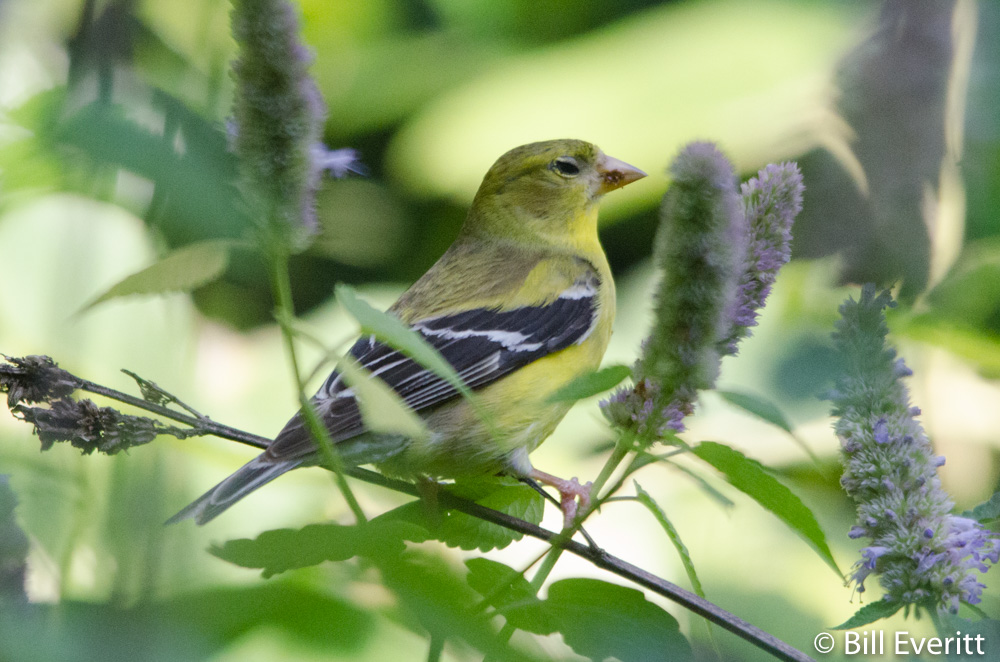
Female Goldfinch on Agastache
You thought nesting season was over for this year. And, except for goldfinches, you’re right. The American goldfinch begins its breeding season later in the year than any other finch and later than any other native North American bird except, occasionally, the sedge wren. Their breeding season is tied to the peak of their food supply, beginning in late July, which is relatively late.

Male Goldfinch on Agastache
The pictures of the two Goldfinches eating Agastache seed on our back deck were taken on July 17, 2015. The male is the brighter colored of the two. Notice that the beak of the female is pinkish, indicating that she’s breeding. You can see a short video we took in July 2013 of two Goldfinches eating from the same Agastache plants.
The American Goldfinch is a granivore and adapted for the consumption of seedheads. Its diet consists of the seeds from a wide variety of plants, including weeds, grasses and trees, such as thistle, dandelion, ragweed, goatsbeard, sunflower, and alder. It also consumes tree buds, maple sap, and berries. Goldfinches will eat at bird feeders, particularly in the winter months, preferring Nyjger seed (nyjer is different from thistle: it comes from Africa and will not sprout). In our yard, they especially love the bird feeders as well as the dried seedheads of Agastache, Coneflowers and Black-eyed Susans.
Their nest is built in late summer by the female in the branches of a deciduous shrub or tree at a height of up to 30 feet. The inside diameter of the finished nest is about 2 1/2 inches. The rim is reinforced with bark bound by spiderwebs and caterpillar silk, and the cup is lined with plant down from milkweed, thistle, or cattail. The nest is so tightly woven that it can hold water, and it’s possible for nestlings to drown following a rainstorm if the parents don’t cover the nest.

American Goldfinches at bird feeders
The chicks hatch 12–14 days after incubation begins. The hatchlings develop quickly, opening their eyes after three days, and completing the growth of olive-brown juvenile plumage after 11–15 days, at which time they begin to practice short flights close to the nest. Then, they join their parents at bird feeders, which is why you’ll notice a spike in the number of Goldfinches in August.


 the Intown Hawk