Category Archives: Wildlife

Raptors in Harm’s Way

Cooper's Hawk - Accipiter cooperii

Cooper’s Hawk – Accipiter cooperii

Late in the day on Monday we were driving on the Georgia Tech campus and a Cooper’s Hawk flew low right in front of the car, barely missing us.  A split second prior to seeing the bird, a squirrel raced across the street in a straight-line hurry.   He was not doing the indecisive squirrel thing that they do in the middle of the road, but running full out.  Clearly the squirrel was in the hawk’s sights.

How often does this happen?  A little homework revealed that it happens much more often than  you might think.  Here’s what we’ve learned.

Urban raptors that we see here are mainly hawks (Cooper’s, Red-tailed and Red-shouldered) and owls (Screech-, Barred and Great Horned).  Hawks are daytime hunters while owls hunt at night, but both may be seen in the twilight hours of dusk and dawn.
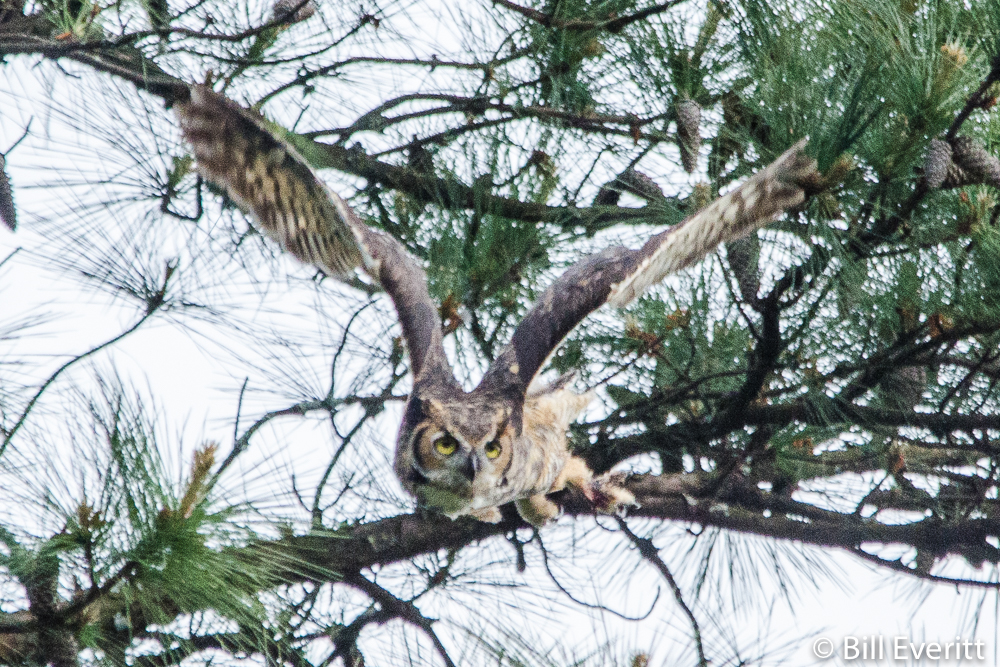
Great Horned Owl - Bubo virginianus

Great Horned Owl – Bubo virginianus

Cooper’s Hawks and owls look for prey from a perch and then move quickly to pounce on a prey animal (‘perch-and-pounce’).  During a chase, these birds are laser focused on their prey, and because their eyes are fixed to the front they often miss objects coming from the side.

Cooper’s Hawks will fly fast and low to the ground, then up and over an obstruction to surprise prey on the other side. [1]

The side of a highway or a city street is an ideal spot for urban perch-and-pounce raptors.  This time of year, the leaves are off the trees and rodents and squirrels have less tall grass and ground cover in which to hide.

Wildlife rescue organizations say that winter brings an uptick in raptor collisions with vehicles.  Speculation is that the increase is attributed to two groups: young first-year birds who don’t yet know the ropes and migrants.  Both groups would be unfamiliar with the territory and the roads. [2]

Although raptors are fast and agile, they are no match for fast-moving vehicles.

Cooper's Hawk - Accipiter cooperii

Cooper’s Hawk – Accipiter cooperii

So, when driving in town, especially in urban neighborhoods with lots of trees and good hunting spots, slow down.  If you see a squirrel, chipmunk or small rodent racing across the street, hit the brakes.  Not just to save the squirrel, but because a raptor may be close behind.  Drive like your children and wildlife live here.

If you hit a raptor and it is still alive, try to get it to an animal rescue facility quickly.

References and Additional Information

[1]  Cornell – All About Birds:  Cooper’s Hawk
[2]  Audubon Society of Portland:  Winter Raptors
[3]  HawkWatch:  Risks to Raptors
[4]  City Wildlife:  Raptors in Our City

No Habitat, No Wildlife

As a rule, we like to keep our content focused on positive things.  However, since this blog is about urban wildlife, we’d have no conscience if we didn’t speak up on an urgent issue that is critical to our wildlife and to each of us here as residents.

More than Thirty-five large trees and countless smaller ones have just been removed by developers in Historic Peachtree Park over the last few weeks from just 2 lots (696 Darlington Rd and 3005 Dale Drive).  Some of these trees had an 80- to 100- year history of growth.  This is a big blow.  And more tree removal signs are up in other parts of the neighborhood.   At this rate there won’t be any Park left in Peachtree Park.

Over 20 concerned neighbors and the Peachtree Park board appealed to the City to save two large specimen oaks on the Darlington Road lot.  You can see these magnificent trees in the photo on the left above.  The appeal was denied and the result is shown below.  Bottom line: a developer can build anything anywhere on a lot, and if a saving a tree is inconvenient, the City’s ordinances permit removal.  In other words, trees come last.

Bluntly put, developers with no long term interest in this neighborhood, clear a lot, often overbuild the property, make a profit and leave.  The developer, a temporary interloper and profiteer, is gone and so are the trees.  This is by now an all too familiar pattern.

Wildlife is victim to this staggering habitat loss.  No trees: no bugs, no birds, no critters.  We are all victims of this loss as well.  We lose our tree canopy, shade, ecosystem services like controlling runoff and cleaning our air, and of course beauty.

3005 Dale

3005 Dale Drive was a wooded wildlife haven. It has now been mostly clearcut and lost more than 21 large trees.

One neighbor posted on the neighbor social media site:

“Is anyone concerned about more and more of the old majestic trees being taken down to make room for new houses/townhomes in our neighborhood?  One of the reasons we moved here was the green feel and the stunning trees in many yards.”

We love to talk about wildlife and the habitat that supports them.  Are we willing to take action to stop its wholesale removal?

What can you do?

  • There are developers and architects who care about trees and work hard to save them. If you’re renovating, seek them out and support them (some even live in our neighborhood).
  • If you’re buying a home, find out what was there before. If the property was clearcut, tell your realtor to keep looking. Let’s raise the bar and send a message we care about trees.
  • And you can support the Peachtree Park Board in their efforts to take a stand against this tree massacre. If you’d like to help, contact the PPCA Landscape Chair Michelle Lyle –  mmlyle@mindspring.com.

Think of it this way: If you have a young child and plant a tree in your yard now, your child will most likely not live long enough to see that tree live to be as old, large and beautiful as this one that was just removed on Darlington Rd.

36-inch Hardwood

We have more information about trees on these pages: Trees & Plants, Tree Size and Age and Special Trees, and we’ll have a follow-up post with more things we can do to protect trees.

The video below shows just some of the wildlife that, in one way or another, depend on trees.  If the trees leave, so do they.  Maybe the wildlife affected by the current habitat destruction will move into your yard where they’ll be safe.