Author Archives: beveritt

Who Cooks for You?

Barred Owl - Strix varia Okefenokee National Wildlife Refuge - November, 2006

Barred Owl – Strix varia
photo taken in the Okefenokee National Wildlife Refuge in 2006

That’s the way we remember one of the calls of the Barred Owl – who_who who_whoooo (who cooks for you).

We’ve been hearing them in our yard and the yards adjoining this spring and summer.  Occasionally we’ll be lucky enough to catch a glimpse of two or three moving around in the pines at dusk.  At least two neighbors have reported that they have them nesting in their back yards.  One says they have been in residence for at least eight years.

Two nights ago at 2:00 a.m. we were awakened to a sound like the caterwauling of a howler monkey.  There were at least two talking back and forth.   Based on Cornell’s All About Birds site, we think this is a mated pair.

I went outside to get a recording and they were moving all around sometimes sounding only 15 or 20 feet away.  But since they are masters at stealth mode, I could neither see them nor hear them fly.  This went on for almost an hour.

Even though we rarely see these birds, we love hearing them at night.  And being such good nighttime hunters they help keep the rodent population in check.  We also have the Great Horned Owl and Eastern Screech-Owl here.  We’ll talk about them in a future post.

Ladybugs

Some call them ladybirds, lady beetles or ladybird beetles. We’ll stick with ladybugs, although the ladybug is not really a bug, but a beetle [1].

Most species of ladybugs are considered useful insects since they eat aphids and scale insects.  In other words, they provide organic pest control.   ‘A single lady beetle may eat as many as 5,000 aphids in its lifetime.’ [2].

LB Cycle 2

Ladybug Life Cycle

There are four phases to the ladybug’s life cycle:  eggs, larvae, pupa and adult.  It will take several weeks to go through the entire cycle.  Some species will have several generations each year while others have only one.

Ladybug Eggs

Ladybug Eggs

One ladybug can lay anywhere from 2 to 350 eggs [3].  This clutch has 28 eggs.

Emerging Ladybug Larva

Emerging Ladybug Larva

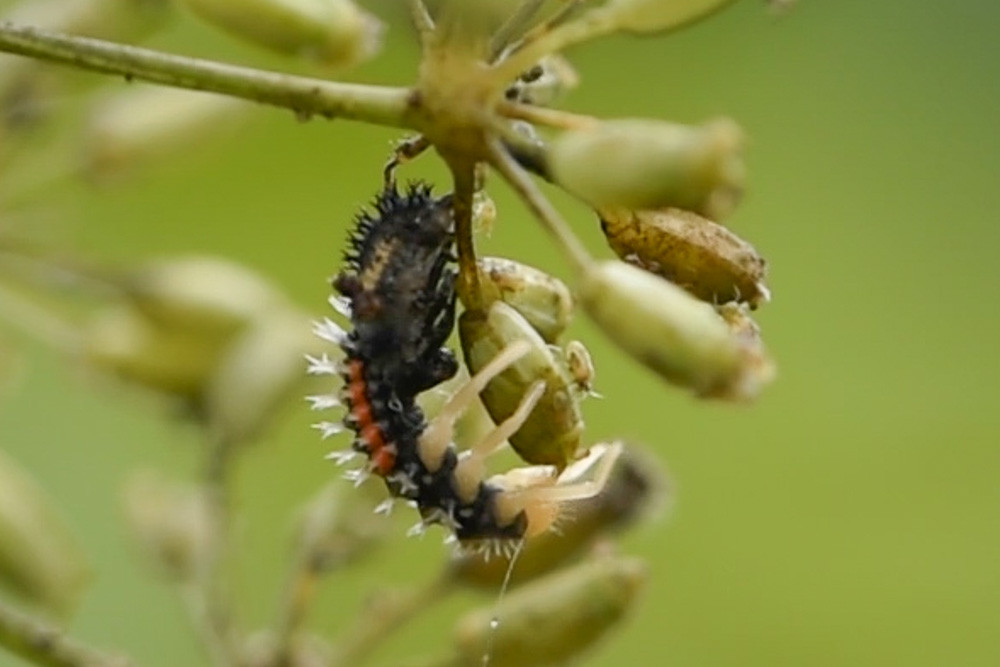
In the larval stage they look like little alligators and are voracious aphid eaters. Once hatched, the larvae eat about 350 to 400 aphids in the 2 weeks it takes them to become fully grown [3] .  They go through 3 or 4 cycles of shedding their skin before entering the pupa stage.  Each iteration is called an instar [4].

LB - Pupa

Ladybug Pupa

The larva will attach itself to a leaf or twig and transition to the pupa stage.   It will remain in pupa form for 2 to 3 days before emerging as fully formed ladybug.

Ladybug New Adult

A ladybug that has just emerged

The newly hatched ladybug will have no spots for the first few hours and will will open and close their wings to dry them.  Slowly the spots will appear.

The short movie below shows the full cycle.

[1]  Australian Museum
[2]  University of Kentucky – College of Food, Agriculture and Environment
[3]  San Diego Zoo
[4]  Wikipedia – Instar