
One week ago we were on Jekyll Island and took the opportunity to visit The Jekyll Island Banding Station – JIBS. This was a great treat, and the folks who volunteer to collect data on birds migrating south were very gracious with their time and information.

White-eyed Vireo – Vireo griseus – Banding Station on Jekyll Island, GA – October, 2016
We talked with Evan Pitman, a third-generation bander, who is heading the effort this year. He told us that they have been banding birds in this location since 1978 – 38 years. From 1978 until 2000 it was run by Don and Doris Coors, and then it was picked up by his father.
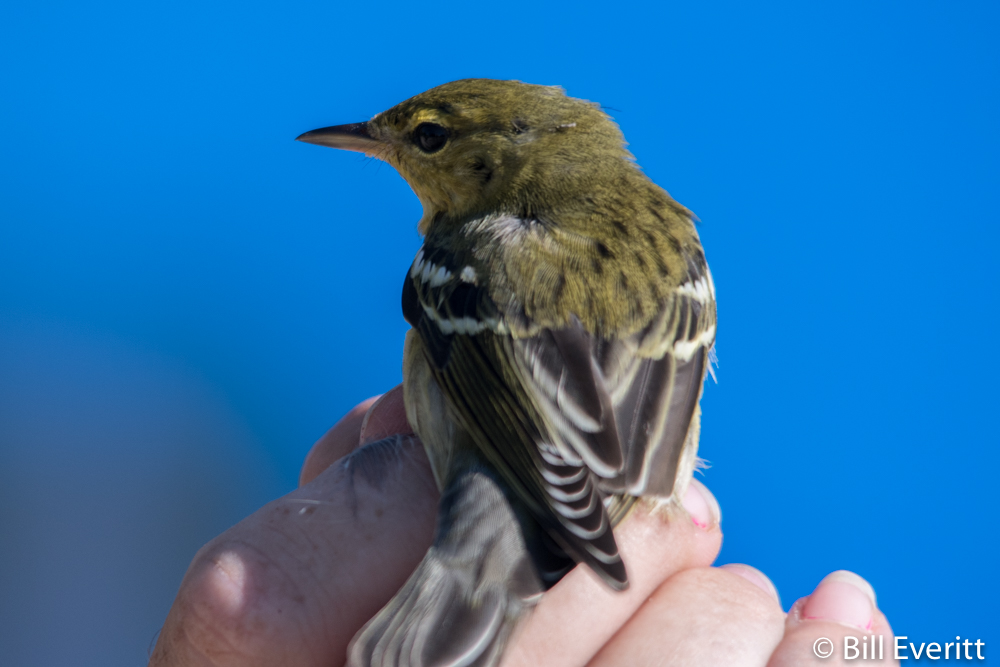
Blackpoll Warbler – Steophaga striata
Evan and the JIBS volunteers catch migratory songbirds in mist nets and then place very light-weight identification tags on them. This enables them to monitor specific species, track individual birds, and collect health information as birds gain mass and fat for migration further south. Some birds are coming to stay, and some birds are just passing through.
Evan told us that in previous years with more people and nets (as many as 27), they banded 2,700 birds one season. This year they have 17 nets and expect to band about 1,500 birds. They’re trying to expand the season from 3 weeks to 4 weeks in order to collect more data.
This location is in the critical path for many of our migrants so JIBS is able to monitor the long-term health of specific species as well as overall numbers. Audubon lists Jekyll Island as an Important Bird Area and says that since 1978, over 40,000 birds have been banded.
We’re lucky to have many of these same birds pass through our area, including Summer Tanagers, vireos, grosbeaks, and many species of warbler.
References and Additional Information
[1] Coastal Birding Georgia blog: Banding on Jekyll Island
[2] Audubon: Important Bird Areas – Jekyll Island Georgia


 the Intown Hawk